Gutters Overflowing Even After Cleaning? Why Pitch and Sizing Matter
Quick Answer: If gutters overflow within a season or two of being cleaned out, debris usually isn't the real problem, the slope or the size of the system is. Gutters need roughly 1/16 to 1/8 inch of drop per foot of run to keep water moving toward the downspout, and a section that's gone flat or reverse-pitched will pool and spill over even when it's spotless. Sizing matters just as much: a 5-inch gutter is built to handle a set amount of roof area and rainfall, and a roof that outgrew its gutters, or a downspout that's too small for the water reaching it, overflows no matter how often it gets cleaned. Fixing either one means checking slope with a level and comparing roof area against gutter and downspout capacity, not scheduling another cleaning.
You just paid someone to clear the gutters, or spent a Saturday up on the ladder doing it yourself, and the next good downpour sends water sheeting over the front edge anyway. It's not sitting in a puddle of leaves this time. It's clean, and it's still spilling over the same spot along the porch roof or above the garage. That's the moment most homeowners around Dayton start to suspect the gutters themselves, not what's inside them, and more often than not, they're right.
Cleaning fixes clogs. But it doesn't touch a gutter that was hung without enough slope, or one that was never sized for the roof it's collecting water from. Those two issues cause the exact same symptom, water pouring over the edge during a storm, and if the overflow keeps coming back after every cleaning, figuring out which one is happening on your house is worth the ten minutes it takes.
Cleaning Solves One Problem, Not the Other Two
A clogged gutter and an overflowing gutter look identical from the ground, but they're different problems with different fixes. Debris blocks water from reaching the downspout at all, so it backs up and spills over wherever the blockage sits. Clear the debris and the water flows again, at least until leaves build back up.
Pitch and sizing problems don't go away with a cleaning because there's nothing physically blocking the flow. The water is moving, there's just not enough slope to keep it moving fast enough, or not enough gutter and downspout capacity to carry the volume a hard rain produces. A perfectly clean gutter with either issue overflows just as reliably as a clogged one, which is why so many homeowners clean the same section twice a year and get the same result.
The tell is timing. If overflow shows up gradually over a few seasons as leaves and grit build up, that's a clog. If it shows up during or right after a heavy storm on a gutter you just cleaned, or if it's always the same stretch no matter how often you clear it, pitch or sizing is the more likely cause.
Why the Slope of the Gutter Decides Where Water Actually Goes
A gutter isn't a level trough. It's built with a slight, continuous drop toward the downspout, typically somewhere between 1/16 and 1/8 inch of fall for every foot of run. That small grade is what moves water along instead of letting it sit.
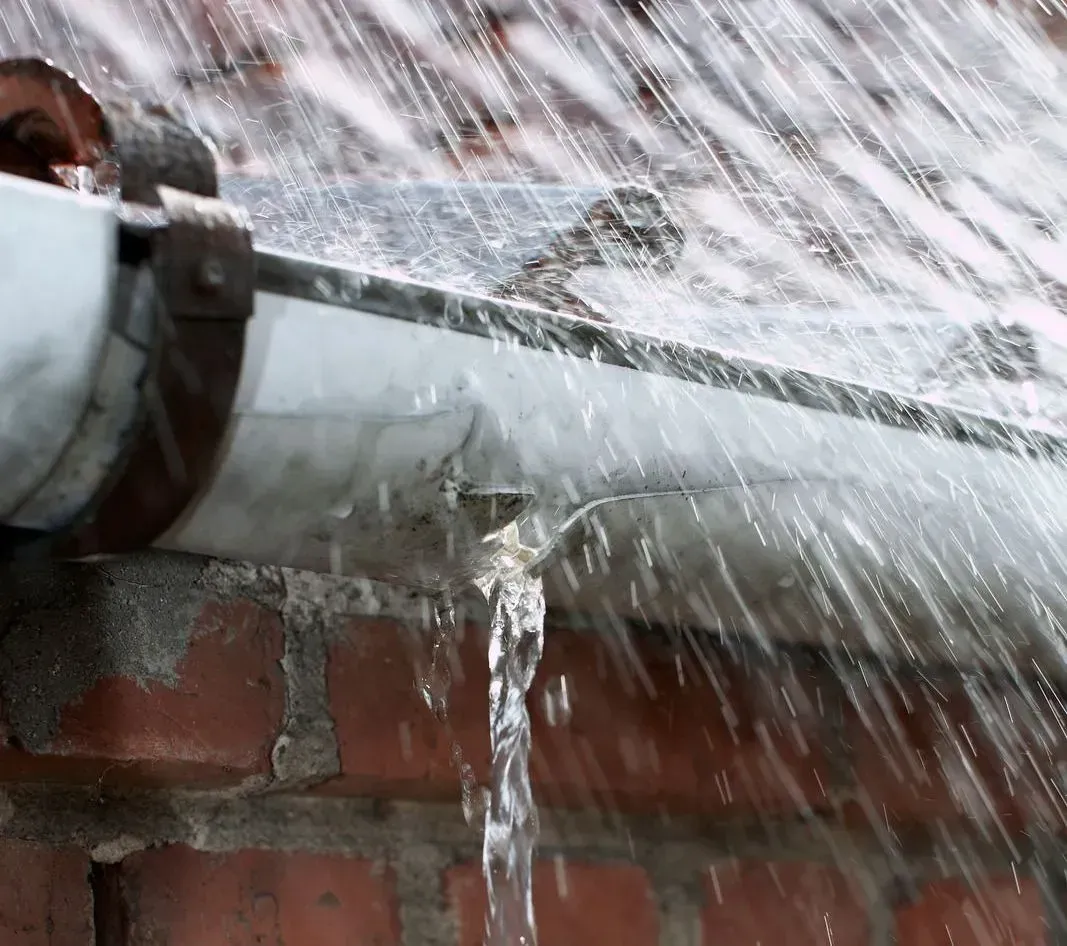
Slope fails in a few predictable ways on houses in this area. Fascia boards flex and sag over the years, especially where wood has taken on moisture, and a gutter hung to a sagging board loses its pitch right along with it. Ice buildup during a Dayton winter adds serious weight to a gutter run, and repeated freeze-thaw cycles can bend hangers or pull spikes loose enough that a section levels out or even tips backward toward the house. Once a stretch of gutter goes flat, water stalls there instead of continuing to the downspout, and the next heavy rain pushes it straight over the front lip.
A run that's too steep causes a different version of the same problem. Water picks up speed faster than the downspout can accept it, and it shoots past the outlet instead of dropping into it. That usually shows up as overflow concentrated right at the downspout connection rather than along the whole run.
Longer gutter runs make pitch problems worse. A run stretching more than about 40 feet is generally built with a slight crown at the midpoint and a downspout at each end, so water only ever travels half the distance in either direction. Pitch a single long run toward one downspout the whole way, and that outlet ends up handling water gathered from twice the distance it should.
When the Gutters Are Simply Too Small for the Roof
Sizing is the piece that gets missed most often, because a gutter can look fine and still not hold enough water for the roof feeding it. Gutter capacity is calculated from the square footage of roof area draining into that run, adjusted for how steep the roof is, since water moves faster off a steep pitch than a shallow one. A standard 5-inch K-style gutter is generally rated for several thousand square feet of moderate-pitch roof area. Once a roof section, or an addition that ties into an existing run, pushes past that capacity, the gutter overflows in hard rain even when it's clean and correctly sloped.
Downspouts have their own capacity limit, roughly one square inch of downspout opening for every 100 square feet of roof area feeding it. A 2-by-3-inch downspout handles a fraction of what a 3-by-4-inch or a 4-inch round downspout can move, and a lot of older homes in the Dayton area were built with the smaller size decades ago, before additions, garages, or extra roof planes were added onto the original footprint.
Tip:
Watch where the overflow happens during the next hard rain. Water pouring over the gutter's front lip along most of a run usually points to a slope or capacity problem, while water shooting past a specific downspout, but running fine everywhere else, usually means that one outlet is undersized or clogged deeper down than a surface cleaning reaches.
There's a regional piece to this too. Ohio has seen a real increase in the number of heavy, two-inch-plus rain events since the mid-1990s, and a lot of gutter systems on older homes were sized around rainfall patterns from decades before that. A system that kept up fine for years can start overflowing more often not because anything on the house changed, but because the storms hitting it are heavier than what it was built to handle.
Reading Where the Overflow Shows Up
Where the water spills over usually points straight at the cause, which makes this one of the easier diagnostics a homeowner can do without climbing anything.
Overflow along one whole side or a long stretch of gutter almost always means a slope problem. Somewhere in that run, the pitch has gone flat or reversed, and everything downstream of that point backs up.
Overflow concentrated at a single downspout, with the rest of the run performing fine, points to either an undersized downspout or one that's too steep just before the outlet, sending water past it instead of into it.
Overflow at roof valleys or wherever two roof sections meet is a sizing issue specific to that spot. Valleys concentrate water from two roof planes into one section of gutter, and a gutter sized for a single plane's worth of water gets overwhelmed right there, even if the rest of the run handles rain without trouble.
Overflow that only happens in the heaviest storms, but never in light-to-moderate rain, usually means the system is sized close to its limit rather than badly undersized. It's handling most rainfall fine and only failing when volume spikes past what it was built for.
What Actually Stops the Overflow
Once the cause is identified, the fix is specific to it rather than a blanket gutter replacement.
Resetting Or Re-Pitching Sagging Sections
A roofer resets hangers along the affected run and re-establishes consistent slope toward the downspout, often without replacing the gutter itself if the material is still in good shape.
Adding A Downspout On A Long Or Heavily Loaded Run
Splitting the water between two outlets instead of one reduces the volume each downspout has to carry and often solves overflow at the far end of a long section.
Upsizing Undersized Downspouts
Swapping a 2-by-3-inch downspout for a 3-by-4-inch, or moving to a larger round downspout, increases the volume that section can move without touching the gutter itself.
Upsizing The Gutter On Roof Sections That Have Outgrown It
Moving from a 5-inch to a 6-inch K-style gutter on the affected run, particularly below valleys or additions, adds meaningful capacity for the same footprint.
Adding A Diverter Or Larger Outlet At Valley Intersections
A valley diverter spreads concentrated runoff before it hits the gutter, reducing the surge that overwhelms a single section.
Warning: Don't assume a gutter guard solves an overflow problem caused by pitch or sizing. Guards are built to keep debris out of a properly sloped, correctly sized system. Installed over a gutter that's already too flat or too small, they add resistance right at the point water needs to move fastest, and overflow during heavy rain often gets worse, not better.
Frequently Asked Questions
Why do my gutters overflow only during heavy rain, not light rain?
That pattern usually points to sizing, not a clog or slope. The system handles typical rainfall but not a hard storm's volume, common where additions tied into an existing run.
How can I tell if my gutters have the right pitch without climbing up?
Watch a heavy rain from the ground and see whether water moves steadily toward the downspout. Standing water left behind after rain stops signals a section that lost its slope.
Can I fix gutter pitch myself?
Adjusting a few hangers on a short, reachable section suits some homeowners, but getting slope consistent across a full run, especially where the fascia has sagged, usually means resetting the entire run correctly.
Does a bigger gutter always fix overflow?
No. A larger gutter helps only when sizing is truly the cause. If the real problem is a flat or reversed pitch, an oversized gutter still overflows, because water isn't reaching the downspout.
How do I know if I need one downspout or two on a long gutter run?
As a guide, runs longer than about 40 feet perform better with a downspout at each end. A roofer confirms based on your roof area and rainfall.
Does old gutter guard installation cause overflow on its own?
It can, particularly where the guard sits over a run already borderline on slope or capacity. The guard doesn't create the underlying problem, but it makes a marginal system overflow more visibly.
Slope and Sizing Explain What Cleaning Cannot Fix
A gutter that keeps spilling over after a fresh cleaning is telling you something the bucket never could. The water is moving, so the trouble sits in the slope that guides it or the size that holds it. Homes across Dayton, Beavercreek, and Centerville, OH show this pattern often, especially where older systems now face heavier storms than they were ever built to handle. Reading where and when the overflow appears usually narrows the cause well before anyone touches a ladder.
The difference between a re-pitched run, an added downspout, and a gutter that outgrew its roof comes down to a hands-on look at slope and capacity together. Chimney Rock Roofing & Construction, LLC
brings 20
years of reading these systems across the region, checking the fall across the full run and weighing
gutter and downspout size against the roof area feeding them. That kind of read turns a recurring overflow into a known problem with a clear, matched fix.